Why is change needed? The "Case For Change"
During Spring 2025 we asked for your views on the “Case for Change”. This formed part of our Better Together programme to shape the future of safe, quality health services for Powys. We have updated our Case for Change to reflect the feedback we heard from you.
During Spring 2025 we asked for your views on the “Case for Change”. This formed part of our Better Together programme to shape the future of safe, quality health services for Powys. We have updated our Summary Case for Change to reflect the feedback we heard from you. Alongside this summary document you can read our full Case for Change as well as more detailed technical chapters covering adult community services, mental health, and primary care. Version 2, October 2025
This document provides a short summary of the opportunities and challenges for health services in Powys. More detailed information is also available. It was first published in February 2025. After listening to staff and public feedback it was updated in September 2025. This is part of an ongoing conversation with you to shape the future of safe, quality health services for Powys.
We have experienced lots of big changes in recent years, including the COVID-19 pandemic, rising demand for treatments, more people living longer with multiple health conditions, growing waiting lists, and large increases in the cost of fuel, food and other bills. Together, these changes also mean that our current health services cost more than we can afford. We need to take action to address this.
As our population and society changes, our health services need to change too.
We need your help to find ways to keep delivering the quality services you need into the future. We also need your help to respond to the challenges the NHS faces. These include:
- Setting out a clear plan to best meet the needs of our communities over the next 10 to 25 years, and helping people to stay well.
- Making sure we focus on the needs of the future, not the legacy of the past.
- Responding to changes in illnesses and treatments, as well as investing more into preventing ill health.
- Ensuring the best quality of care, experience and outcomes for patients.
- Building a sustainable workforce and reducing our need for expensive agency staff.
- Improving our buildings and facilities so they can support our future needs.
- Meeting our legal duties and responsibilities, including our Duty of Quality which is summarised in the image below. Our decisions must be guided by Safety, Timeliness, Effectiveness, Efficiency, Equity and putting the Person at the Centre of their Care.
- Developing future options that Wales can afford.
- Building on the learning and the talents of the people here in Powys.
We will do this through a programme called Better Together. Better Together is our promise to work together with you to review how and where we provide services, to ensure safety, to improve quality, and to make best use of resources that we can. We want to talk to patients and service users, people and communities, health and care staff, and our partner organisations.
We have some excellent foundations to build on. We are proud of our organisation and the skilled and dedicated people that make it work. We also have a compelling vision for the future. This is set out in the Health and Care Strategy for Powys.
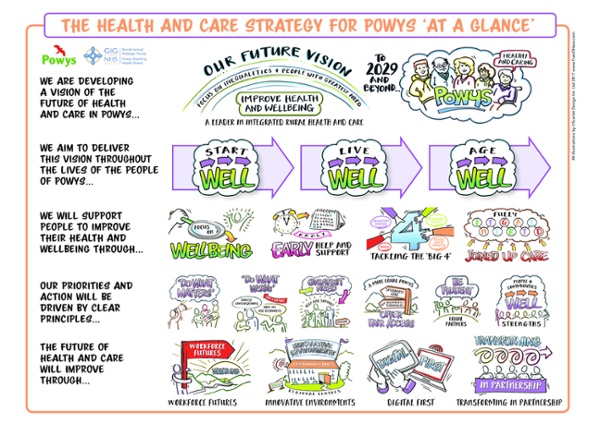
Thousands of people across Powys contributed to this Strategy in 2015 and 2016, and have continued to inform and influence its delivery ever since.
And it is clear that “no change” is not an option. Better Together will help us to deliver the Strategy by working together to shape the future of safe, quality health services for Powys.
Seeking your views on our Case for Change was the first part of this journey. We asked for your views and experiences so that we have a shared understanding of the problems we need to solve.
Our Better Together journey is continuing. We encourage you to continue to stay involved.
Together we will build a vision for safe, quality health services that we can all be proud of.
Better Together is about building on the strengths we have in Powys, addressing weaknesses, finding opportunities to improve, and responding to challenges.
We are already strong in some important areas, and we want to take every opportunity to improve how we deliver safe, quality health services for the future. Here are some examples that staff and patients have shared with us.
We have a dedicated and caring workforce, many of whom live in thriving, proud and neighbourly Powys communities.
The model of primary and community care in Powys is one of the most well developed in the country. This is the care provided to you by your local GP, community nurse, dentist, pharmacist, optometrist, community mental health teams, and allied health professionals locally in communities across the county. These services are stronger here in Powys than in many other parts of the country, but we recognise that these services face challenges too, such as access to dentistry.
We have good relationships with our neighbouring Health Boards and Trusts. This includes the network of district general hospitals (DGHs) around our borders. We buy services from them that we cannot provide ourselves here in Powys. This includes acute and specialist hospital services that cannot be provided safely within Powys due to our small and scattered population.
We are using new digital technologies, so that more patients can access more services at home or close to home. In doing this we recognise that some digital services will not be suitable for everyone.
We live and work in a county that is supported by the work of amazing volunteers, community organisations, and unpaid carers.
Improving the health of our population is a very important part of our heath and care services. We deliver good support to help people improve their lifestyles – including services like Help Me Quit, social prescribing to promote active lifestyles, and healthy eating.
Our preventative vaccinations for flu and other seasonal diseases help protect health. Screening programmes are also essential to spot early signs of disease.
Our work to manage and integrate the services we buy for our patients helps provide continuous care whichever health or social care organisation is providing that service.
As well as building on our strengths, we need to respond to the challenges we face. Here are some examples shared with us by staff and patients:
Patient Quality and Outcomes
When a person stays still for a long time, their muscles and overall strength can weaken because they haven't been moving around much. This often happens when someone stays in bed for a long time, like during a hospital stay. It makes walking, standing, and everyday activities harder. This is a challenge for PTHB, as we often have older patients who are medically fit to go home but cannot access the right care and support to help them recover at home. This means that many will stay in hospital until the right care can be found for them. Evidence shows that 10 days in hospital can lead to the equivalent of 10 years’ worth of ageing in the muscles of people over 80 years old.
Our population is spread across a very large county, which can make it difficult to deliver consistent high-quality local services. As a small health board, we depend on a limited number of specially trained staff. Currently, one in seven of our roles is vacant. This makes delivering services and reducing waiting times even more difficult. Our waiting times got longer during the COVID-19 pandemic. We must find ways to deliver the right care and treatment solutions in a safe, sustainable way and that limits the harms caused by longer waits. Our statutory Duty of Quality is an important part of this work.
Our Buildings and Facilities
Many of our buildings are older than the NHS itself. Over a third (36%) were built before 1948, which is much higher than the Wales average (12%). Older buildings are hard to heat. The space is less flexible, which makes it difficult to deliver modern healthcare services. As we develop our plans, we need to find the best way to use and improve our buildings in ways that are affordable.
One question we are often asked is why there is no District General Hospital (DGH) in Powys. Our small population and the large and rural nature of the county means it is not safe or practical to provide a DGH within Powys. DGHs need to serve large populations so that they can bring together the right skills and services to treat you in an emergency. Experts say that a DGH should serve a population at least three times the size of Powys. Our geography is also a challenge. Even if a DGH could be provided in a central Powys location, most people in north and south Powys would still be closer to a DGH elsewhere.
Therefore, we buy many of these specialist hospital services for Powys residents from neighbouring health boards in Wales and neighbouring NHS Trusts in England. This process is called “commissioning”. We have strong relationships with our neighbours to provide the care you need.
Our Workforce
We are very proud of our passionate and committed workforce, who work hard to provide high standards of care in Powys. But there are national and international workforce shortages in some professions, which affect us here in Powys too.
Powys is a beautiful place to live and work, but our remoteness can also make it difficult to attract as many new staff as we need. Serving a small population within a very large rural area can be difficult, and the lifestyle does not appeal to everyone.
These challenges mean we have historically used expensive agency staff to maintain our most important services. The amount we spend on agency is much higher than the average for the NHS in Wales. Of every £100 we spend on wages, nearly £10 is spent paying for agency staff. This compares with the Welsh NHS average of nearly £3.
The Powys population is older than the UK average, with well over a quarter of Powys residents over the age of 65. This is also reflected in our own workforce. Just under half of our workforce are aged 50 and over. Official population estimates show that by 2043 Powys will have 6,512 fewer people of working age than in 2024. This will affect our ability to recruit NHS workers from within our local communities.
As our population continues to age, it is also getting more difficult to attract younger people from the county into healthcare roles. Many of our young people choose to leave Powys in search of opportunities elsewhere. We are working hard to provide local training and development opportunities, but this cannot deliver all that we need. For example, our Aspiring Nurse Programme supports people to live, train and work in the county. We have also had some success in attracting international nurses, who have made Powys their home and have helped strengthen our services.
Digital
We have made good progress on providing digital services in recent years, but there is more to do. Parts of Powys do not have access to the good broadband or mobile data needed to support digital technologies. Having an older population also tends to be associated with lower levels of digital access and digital confidence. Our small rural population and geography can also make it difficult to reach everyone and drive down costs.
There can also be challenges with sharing patient records with hospitals between different parts of the NHS (services directly provided by Powys Teaching Health Board, compared to NHS services outside Powys, and GP services). Patients tell us about their frustration with this.
Finance and Commissioning
Powys, like many other parts of the NHS, is facing big financial pressures. Balancing rising costs against the needs of patients and the demand for services within our available resources is a key challenge for us right now.
We receive funding of over £400 million per year – that is around three thousand pounds per person. Some people will use very few services each year. Others have highly complex needs requiring very expensive packages of care. They may experience life-changing injuries needing many different types of surgery and ongoing care. Or they may have serious illnesses requiring expensive drugs and treatment.
Right now, the health services we provide and commission for Powys residents cost more than our funding. In fact, for every £100 we spend, we are overspending by £3 (we ended 2024/25 with a deficit of around £16m). This is despite making significant savings (around £5 in every £100). These include reducing back-office costs and reducing the amount we spend on expensive agency staff.
We have made the difficult decision to commission (“buy”) planned care from hospitals in England based on the NHS Wales waiting times targets. This is not a decision we have taken lightly, and it reflects the way we are funded. We must take action to live within our means, or we will build up bigger financial difficulties for the future.
Access to care
Powys is a very big county but with a small population. The rural nature of the Powys can make it challenging for patients to travel to service due to long travel times and limited public transport options. It also makes it more difficult for us to provide services.
Next Steps
Collectively, these challenges mean that “no change” is not an option. We must work together to plan for an NHS based on the needs of the future.
We must also plan how we best respond to increasing levels of ill health, adjust to having fewer people of working age in the county, and adapt buildings which were designed for outdated models of care.
We will be reviewing each of our service areas in turn, and based on feedback from the county’s health care professionals we propose to focus on these areas first:
- community services & adult mental health services, then
- planned care & diagnostics, then
- women & children’s services.
We can all play a part in improving the health of Powys and reducing inequalities.
Powys is a rural and sparsely populated county. In fact, there are just 26 people per square kilometre, compared with over 2600 people per square kilometre in Cardiff. This means that many residents benefit from access to outdoor spaces. But travel to services can be more challenging in rural areas than in built up areas. This is particularly the case for more specialist services that need to be provided outside Powys.
Nearly 134,000 people live in the county, and life expectancy is amongst the highest in Wales. The number of older people is rising, and this also means that the needs and demands for health services are increasing. But the proportion of the people of working age is reducing.
There are opportunities for all of us to work together to improve health and to prevent ill-health. Lots of different factors affect how healthy we are.
Evidence suggests that healthcare services account for about 20% of this. Other factors play a much bigger role. In fact, 30% of our health status is due to our own behaviours such as smoking, diet, physical activity, and alcohol. If we adopt healthy behaviours this can reduce the risk of illness, and can help the NHS.
10% of our health status is due to our physical environment. This includes the buildings that we live in, and access to green spaces.
40% of our health status is due to factors in wider society. This includes our education, job status, income, family & social support, and community safety.
Through Better Together we can work towards a Powys where people live longer and healthier lives, and have fair access to the things that lead to good health and well-being:
- Promoting healthy behaviours
- Promoting and supporting mental and social well-being
- Tackling loneliness and isolation
- Influencing the wider determinants of health
- Making sure that health and care services focus on prevention and early intervention
- Providing excellent public health services such as screening, vaccination and Help Me Quit
- Tackling the public health effects of climate change
We are listening to the issues that matter to you. Here are some key themes from your feedback to us during the last 18-months:
- Health services are highly prized and are a source of civic pride. Local services really matter to you, and especially those that are provided by and with local communities, including volunteers and unpaid carers.Y
- You are worried about the distance to District General Hospitals for planned and emergency care. This includes access to public and community transport services and ambulances, including the recent review of air ambulance services.
- You are concerned about the increasing pressure on services, and particularly about longer waiting times for planned care and for treatment at emergency departments.
- You tell us that the experience of patients and service users can vary a lot depending on where you live, and which DGH you use. For instance, waiting times for planned care are often shorter for patients that receive treatment in England, compared to Wales.
- You are worried about the impact of our recent decision to ask English hospitals to plan their services based on Welsh waiting time standards.
- You want to feel safe to grow old in Powys. This is particularly important to you if you are living with multiple health conditions. You can also see that our staff group is getting older too.
- You are concerned about the availability of social care – and how the NHS, local authority, third sector and private care providers work more closely together to help you get home from hospital faster and with the right support.
- You experience difficulties in the way information is shared between the people and organisations providing your care. For example, sometimes when you attend an appointment outside Powys the clinician does not have access to your notes, or your GP does not have access to the results.
- Many of you welcome the use of digital technology that helps you access care and support in ways that fit around your life. You also highlight that some patients need more help to confidently use digital services, some are not comfortable using digital services at all, and that digital access can be a challenge in parts of Powys.
- Social isolation and loneliness are a big concern. Living in a sparsely populated county can affect access to support, including from unpaid carers, which also affects mental and emotional health.
- You want to see a bigger focus on preventing ill health and supporting people and communities to take more responsibility for their health and wellbeing, so that a state-funded NHS can focus on those most in need.
- You want quicker access to local community healthcare services.
We recognise that this can only provide a snapshot of the issues that you have raised with us, but we hope it reassures you that we are listening and that through Better Together we want to work with you to find solutions that work in our rural context.
Thinking specifically about community health services, here are some of the issues raised with us by patients and staff:
- People recover faster in their own home, which is why we want to support people to stay at home or return home from hospital when it is safe for them to do so. We are working with our Primary Care colleagues to invest in extra staff to help people stay in their own homes longer, as well as a new falls service, too.
- Long stays in a hospital bed can badly affect the fitness and independence of patients, which can have long term effects on their health. The national goal is to reduce the number of hospital stays that are longer than 21 days, but here in Powys the average is 40 days which is too long. We have made temporary changes to our bed model to help us provide the right care, but more action is needed.
- Getting home from hospital is often delayed because of availability of home care and residential care in the county.
- There are better ways to provide care at the end of life. Most people would prefer to die at home, or somewhere that feels like their home, with their loved ones near. Care for people with terminal illnesses is best provided at home, but sometimes they must be admitted to hospital to help manage their symptoms – but too many people from Powys are dying in hospital.
- We have many excellent community based specialist nursing and practitioner services providing advice, support and treatments to patients with long-term conditions. But Powys has a small population meaning these teams are small and therefore thinly spread across a large county. Annual leave and sickness absence can have a big impact on small teams and how their services are delivered.
- The cost of providing Continuing Health Care (CHC) has increased by 128% in the last five years. There may be opportunities to change the way we provided CHC through enhancing community services that provide better care for patients and also reduce the need for pay for expensive care packages.
- During 2023/24 Powys residents accounted for 40,000 admissions to our own and out-of-county hospitals, with an average of 109 people admitted each day. On an average day within the NHS system, our residents occupied 421 beds both in Powys and outside the county. This is equivalent to 154,000 ‘bed days’ each year at a cost of £104 million.
- Almost one in six of our roles providing community inpatient services are vacant. These gaps are filled using expensive agency staff. This is not affordable and does not provide the quality of care we want.
- Demand for urgent and emergency care is growing, and this is linked to our ageing elderly population. People are experiencing delays in accessing emergency care. One factor is ambulance response times. Another is because too many DGH beds are occupied by patients who no longer need them, but who cannot be discharged home because of the pressure on social care services.
- Powys Minor Injury Units (MIUs) are meeting or exceeding quality and performance targets, but people are concerned about the temporary overnight closures.
Thinking specifically about adult mental health services, here are some of the issues raised with us by patients and staff:
- Our single point of access from the “NHS 111 Press 2 for mental health” service has improved patient access to services, including for the availability of mental health support through the medium of Welsh.
- Demand for mental health services is rising, and people are waiting too long for an assessment, support or treatment. The longest waits are for psychological therapies, memory assessment service and neurodevelopment services.
- Patients in our adult and older adult population are experiencing increasingly complex mental health and learning disability needs. We must change how we work else we will not keep pace with demand. Without action, we expect demand to increase by one third within a decade.
- Investment in prevention, and in improving the overall well-being of our population, will help manage demand.
- Mental health challenges still carry a social stigma, and sadly patients can face exclusion from work and society, which makes their difficulties worse and harder to recover from.
- People who face greater levels of poverty, isolation, loneliness, crime, homelessness and substance misuse, have more mental and physical health problems.
- The mental health needs of our population are changing and becoming more complex. More people with learning disabilities are needing support from our adult mental health services.
- Our workforce is spread thinly throughout the county. It is a fragile resource, and reported levels of sickness and vacancy rates are high compared with the average for the health board. This affects our ability to meet national targets and service standards.
- Facilities are spread out across Powys, and our buildings were not designed to meet the needs of a mental health and learning disability service, so we need more staff to run them as a result. Better facilities would improve patient services and reduce the number of staff needed to safely operate them. We also need to make decisions in relation to Crug Ward in Brecon, which is temporarily closed.
- The UK-wide shortage on mental health nurses directly affects our vacancy rates here in Powys. We have plugged gaps by employing agency workers. The cost of this continues to grow and does not provide the level of care we would like for our patients.
- We have improved our success in attracting new staff, including through our Aspiring Nurse programme. With the exception of our Psychology service, our vacancy rate has fallen by nearly three quarters since 2022.
Better Together is our conversation with you to shape the future of safe, quality health services for Powys.
We encourage you to stay involved.
There is lots of useful information on our Better Together website. Visit https://pthb.nhs.wales/BetterTogether
You can:
- Read more about the Case for Change, including our full Case for Change and our technical chapters on Adult Community Services, Mental Health and Primary Care
- Read more about our engagement during Summer 2025 on adult physical and mental health community services
- Sign up for regular email updates to keep you informed and involved
Together we will build a vision for safe, quality health services that we can all be proud of.